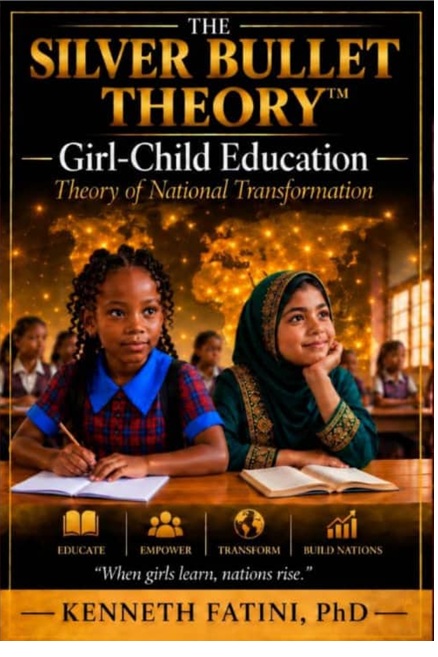
THE SILVER BULLET THEORY™
Girl-Child Education — A Theory of National Transformation
When girls learn, nations rise.
The Theory in One Proposition
The Silver Bullet Theory™ advances a simple but consequential proposition: educating the girl-child is not merely an educational or social intervention. It is a strategic investment in national transformation. When girls gain sustained access to quality education, the benefits can extend across health, household welfare, economic participation, demographic change, institutional capability and the prospects of succeeding generations. Because these effects interact and reinforce one another, girl-child education can become an unusually powerful multiplier of national development.
Why Girl-Child Education?
Education changes the capabilities of an individual. Educating a girl can do more: its effects can travel through families, communities, economies and generations. An educated girl is more likely to enter adulthood with greater knowledge, agency and economic opportunity; these gains can influence health, household decision-making, the education of children and participation in economic and civic life. The significance of girl-child education therefore lies not in a single outcome, but in its capacity to activate several developmental pathways at the same time.
- Health — stronger maternal, child and household health outcomes
- Education — greater intergenerational transmission of learning
- Economic participation — expanded skills, productivity, earnings and opportunity
- Demography — greater agency over marriage, fertility and family formation
- Household welfare — stronger capacity to influence income, nutrition and investment in children
- Institutions and society — broader participation in civic, professional and public life
- Future generations — developmental gains capable of compounding across generations
From Education to National Transformation
The transformative power of girl-child education lies in the interaction among these pathways. Improvements in health can strengthen educational continuity and economic participation. Greater economic participation can strengthen household welfare and investment in the next generation. Changes in agency, fertility and family formation can influence demographic structures and national human-capital formation. Over time, these interconnected effects can accumulate across households, communities and institutions.
The Silver Bullet Theory™ describes this process as a development multiplier: an initial investment in the education of the girl-child generates effects across multiple systems, with each pathway capable of reinforcing others. National transformation emerges not from education acting alone, but from the cumulative interaction of these effects across time and generations.
Girl-Child Education
↓
Multiplier Effects
↓
Intergenerational Gains
↓
National Transformation
Explore The Silver Bullet Theory™
The Silver Bullet Theory™ is developed as both an explanatory framework and a basis for policy and practice. Explore the theory in greater depth, examine the book in which the framework is systematically developed, learn about its author, or consult the growing collection of research and evidence resources supporting its continued development.
About the Theory — Explore the central proposition, developmental pathways and conceptual foundations of The Silver Bullet Theory™.
The Book — Discover The Silver Bullet Theory™: Girl-Child Education — A Theory of National Transformation and the argument developed across the book.
About the Author — Learn about Kenneth Fatini, PhD, and the professional and intellectual background from which the theory emerged.
Resources — Access selected international evidence sources, research themes and supplementary materials associated with the theory.
When girls learn, nations rise.